Appeals Court Questions Trump National Guard Deployment in D.C.
Erin Calloway
Updated Oct 19, 2026
Federal appeals court judges questioned the Trump administration October 14 about the limits of presidential authority to deploy National Guard troops in Washington, D.C., more than a year after the mission began.
The hearing did not end the deployment. A stay of a lower-court ruling allowed the troops to remain while the appeal proceeded, leaving a continuing military presence on city streets as judges examined who could legally authorize it.
Judges pressed the administration on the limits of its power
Judge Judith Rogers asked the government’s attorney, Eric McArthur, what limited a president’s authority under the administration’s interpretation. McArthur said the president had to be calling out the Guard in aid of civil authorities, AP reported.
Judge Cornelia T.L. Pillard questioned how that argument interacted with the Posse Comitatus Act, the 1878 law restricting the use of the federal military for domestic law enforcement unless authorized by the Constitution or Congress.
The questions went beyond whether officials considered the mission useful. They concerned the legal basis for using troops in policing-related activities and whether the administration’s interpretation left meaningful boundaries.
Washington’s status makes the case different
D.C. is a federal district, not a state. The Constitution gives Congress authority over it, while the 1973 Home Rule Act allows residents to elect a mayor, council and neighborhood commissioners.
That arrangement is central to the litigation. The administration argues that the president has distinctive powers in the capital. The District argues that the deployment unlawfully intrudes on local control of law enforcement.
D.C.’s attorney, Mitchell Reich, also faced questions about circumstances in which the president could act. He acknowledged authority to deploy the Guard to suppress organized violence in the District, according to AP. The dispute is therefore not whether deployment could ever be lawful, but whether the authority covers this mission.
The earlier ruling distinguished crime control from federal protection
U.S. District Judge Jia Cobb ruled in November 2025 that the deployment illegally intruded on local officials’ authority. Her ruling distinguished protecting federal functions and property from unilaterally using the Guard for general crime control or bringing in troops from other states.
A different appeals panel stayed that ruling in December. In doing so, it cited considerations including disruption to service members and the president’s interest in protecting federal functions and property.
The stay allowed the mission to continue; it did not substitute for a final decision on the appeal argued October 14.
The mission has grown into a long-term presence
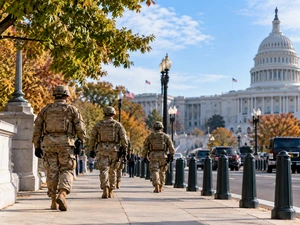
Trump began the deployment in August 2025, describing it as a crime-fighting effort. Personnel have supported arrest operations, patrolled neighborhoods and participated in cleanup work.
AP reported that troop numbers peaked around 5,000 during summer celebrations and had fallen to about 2,900 by the week before the October 14 hearing. The Defense Department had extended the mobilization through January 2029, and the government awarded a $292 million contract for apartments for task-force members.
The administration credits the deployment with reducing crime, while AP noted that crime had already been declining before troops arrived. City officials and activists oppose the mission on grounds including cost and militarization.
Those competing assessments give the case practical stakes, but they do not resolve the authority question. The October 14 arguments concerned the legal basis for an ongoing deployment, with the administration defending the mission and the District seeking to enforce limits on federal intervention.
References: Court hears arguments on National Guard deployment in DC

AI-Assisted Content
The News And Beyond team was assisted by generative AI technology in creating this content.
Trending


Companies Got Tariff Refunds. Some Money Went to Bonuses
Stanley Black & Decker raised prices while import tariffs increased its costs. Now the tool...
Thomas Hale


Funeral Costs Top $7,700 as Families Take on Debt
A new consumer advocacy report says the average funeral now costs more than $7,700 and...
Daniel Reeves

New Food Aid Proposal Could Affect Millions of Families
The Trump administration has proposed tightening the rules used to qualify households for food assistance,...
Thomas Hale

Health Savings Limit Rises to $9,000. Medicare Can End Your Contributions
Americans with qualifying health insurance will be able to contribute up to $9,000 to a...
Laura Bennett

Dorit Kemsley Finds a New Home After $7 Million Mansion Dispute
Caption: Dorit Kemsley in a 2016 video still. Photo: The Street Interviewer / Wikimedia Commons....
Susan Blake


Blink-182's Mark Hoppus Won His Tree Fight. He Still Wants $681,000
Caption: Mark Hoppus performing at the 2020 ALTer EGO concert. Photo: Justin Higuchi / Wikimedia...
Emily Carter


Used GoodRx Before April 2024? A $32 Million Settlement Has a Deadline
People in the United States who used any GoodRx website, app or service before April...
Laura Bennett


Renters Could Share $48.5 Million in Settlement Funds
Renters affected by alleged hidden fees and improper security-deposit deductions at Progress Residential could receive...
Ryan Ellis

Hilary Swank, Pregnant at 52, Tells Critics to Get With the Times
Caption: Hilary Swank at the 2015 Tokyo International Film Festival. Photo: Dick Thomas Johnson /...
Susan Blake

Paul Pierce Disputes $8,508 Child Support Complaint
Caption: Paul Pierce playing for the Washington Wizards, February 2015. Credit: Keith Allison / CC...
Emily Carter