Why the April Jobs Report Is Raising New Labor Questions
Thomas Hale
Updated May 10, 2026
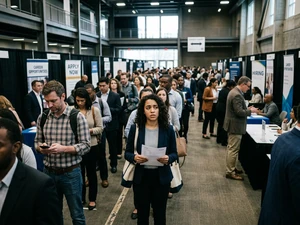
The headline number from April’s jobs report looked, on the surface, stable: 115,000 new jobs added, unemployment unchanged at 4.3 percent. But economists and labor market analysts tracking the underlying data are reading a more complicated story - one about a labor market that is neither falling apart nor returning to health, and whose pressures are being felt unevenly across the American workforce.
What the April Numbers Showed
The 115,000 jobs added in April fell well below the Wall Street consensus estimate of approximately 175,000, according to CNBC. It also came after an unusually strong March figure of 185,000, suggesting continued volatility rather than a clear trend. The Bureau of Labor Statistics separately reported that average hourly earnings grew 0.2 percent for the month - below the 0.3 percent estimate - with annual wage growth at 3.6 percent, below the 3.8 percent forecast.
The broader U-6 measure of labor underutilization, which captures discouraged workers and people working part time who want full-time employment, rose to 8.2 percent in April - up from 7.8 percent a year earlier. That measure is considered a more complete picture of labor market stress than the headline unemployment rate.
The Federal Workforce Factor
Federal government employment declined by another 9,000 in April, extending a reduction that has now reached approximately 348,000 workers since October 2024. Fortune analysis noted that for much of 2025, essentially the only reliable source of job growth was government and healthcare hiring - and DOGE-related reductions removed one of those two anchors from the picture.
The healthcare sector added 54,000 jobs in April, continuing its role as the single most consistent contributor to job creation. Transportation, warehousing, and retail trade also showed modest gains. The information sector - encompassing technology, media, and data processing - continued to shed jobs, reflecting a broader structural shift that has been underway for the past two years.
Low Hiring, Low Firing - and What That Means
Economists have increasingly characterized the current labor environment as low-hire, low-fire - a market where layoffs remain near historical lows but new hiring has also contracted sharply. ZipRecruiter research documented that long-term unemployment has been rising even in this environment, as workers struggle to find new positions despite not being actively laid off.
The Chicago Federal Reserve Bank president told CNBC that the job market has been ‘stable without being good’ for roughly a year and a half - a description that captures the paradox of a market that statistically looks healthy but feels tight for workers navigating it in practice.
The Policy Complications
The Federal Reserve voted to hold interest rates steady in its most recent meeting, with the highest level of dissenting votes since 1992. Officials acknowledged disagreement about the direction of policy given simultaneous pressures from tariff-driven inflation and a softening labor market - a combination that makes the standard toolkit harder to apply cleanly.
For workers watching the numbers each month, the bigger question is simpler than the policy debate: whether the job that exists, or the job being sought, will still be there in three months. On that question, April’s report offered evidence of continued stability - alongside enough uncertainty to keep the question open.
References: Jobs Report April 2026 | Empsit.Nr0

AI-Assisted Content
The News And Beyond team was assisted by generative AI technology in creating this content.
Trending
The credit card hack that could save you hundreds on interest
0% intro APR and up to 10% cash back - this card is everything you need to beat high interest and rack up rewards.
Sponsored

Retired? You Might Be Missing Out on These Money Moves
You’ve worked hard for retirement—now make sure you’re getting everything you deserve. These 10 little-known money moves could make a big difference.
Sponsored
Some families are adding this to their emergency kit
Designed for emergency situations, this device is being added to homes as an extra layer of preparedness for families.
Sponsored

Former AT&T Unlimited Customers Who Missed Their Refund Are Getting Another Payment by Zelle
Some former AT&T unlimited-data customers who missed an earlier settlement payment are getting another chance...
Ryan Ellis
The Dumb Money Mistake You’re Probably Still Making
You may be wasting money in ways you don’t even notice. These smart tips could help you spot hidden budget leaks and keep more cash in your pocket.
Sponsored

A Federal Judge Blocked Trump's New Birthright Citizenship Order Before It Took Effect
President Donald Trump's latest attempt to narrow birthright citizenship has been blocked before it can...
Erin Calloway

Hands Down One Of The Best Credit Cards For Balance Transfers
Stop letting high-interest credit card payments eat into your budget. Paying those steep rates every month? It’s like throwing money away!
Sponsored
Social Security's 2027 COLA Is Estimated at 3.6% Ahead of the October Decision
AARP currently estimates that Social Security benefits could receive a 3.6% cost-of-living adjustment for 2027,...
Alex Mercer

No Poison, No Traps: This Outlet Device Has Homeowners Rethinking Pest Control
What if dealing with mice or roaches did not have to start with another trap under the sink? This tiny plug-in device is designed for people who want a cleaner, simpler way to look at indoor pest control.
Sponsored

Betty White Left Money for the L.A. Zoo, but the Trust Hit a Legal Roadblock
Betty White left instructions for regular donations to support the Los Angeles Zoo, but a...
Susan Blake

Is your car insurance getting…expensive?
The team at FinanceBuzz believe they could help. Check out this free tool from FinanceBuzz to shop for better car insurance options in just a few clicks! You could be matched with top providers and save hundreds by switching!
Sponsored

Diddy Sued for $100 Million. The Lawyer He Blames Could Not Get It Dismissed
Caption: Sean Combs in 2007. Credit: David Shankbone, via Wikimedia Commons, CC BY-SA 3.0. Sean ‘Diddy'...
Emily Carter

Calm Your Mind in Just 4 Minutes — Without Pills Or Meditation!
This device uses clinically proven vagus nerve stimulation to calm your body and mind naturally. It feels like a pleasant, light vibration on your neck and helps you relax FAST!
Sponsored

Up to 1 in 10 Medicare Advantage Members May Need a New Plan for 2027
A sizable group of Medicare Advantage members may have to choose new coverage for 2027...
Daniel Reeves

Analyst Says UnitedHealthcare Dropped About 13% of Its Medicare Advantage Plans Across 18 States
UnitedHealthcare has dropped about 13% of the Medicare Advantage plans it offered across 18 states...
Alex Mercer
Selena's Brother Says He Was Owed 25% of Her Profits. He Is Suing Their Sister
Caption: Selena & Los Dinos in 1988. Credit: Unknown, Public Domain. Selena Quintanilla's brother says a...
Susan Blake

Sean Combs and His Lawyers Split Over Unpaid Bills in a $100 Million Case
Caption: Sean Combs at the Cannes Film Festival on May 19, 2012. Credit: Nicolas Richoffer...
Susan Blake

Canadian Whisky, Dairy and Some Motorcycles Will Be Banned From U.S. Imports Sept. 29
Some Canadian whisky, dairy products and motorcycles will be barred from entering the United States...
Thomas Hale